Former Michel Indian Band No.472
This timeline highlights important dates and events of the former Michel Indian Band No.472.
-
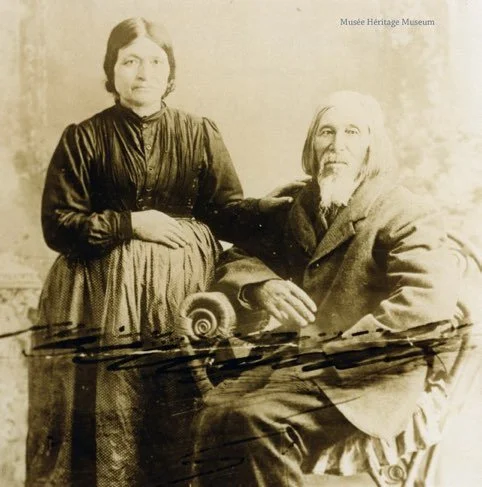
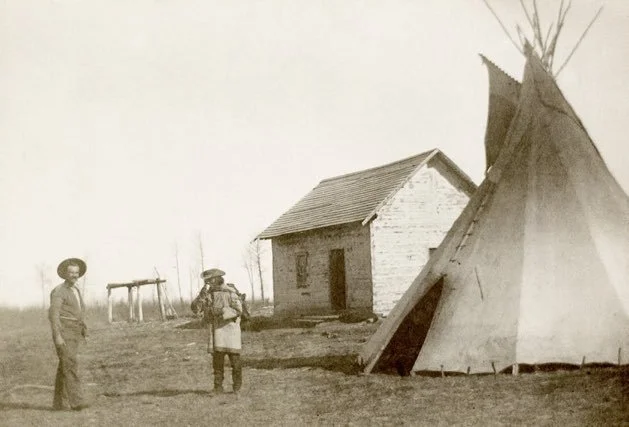
A group of people of Iroquois and Cree descent — including ancestors of the Michel Band — lived northwest of what is now Edmonton, Alberta.
-
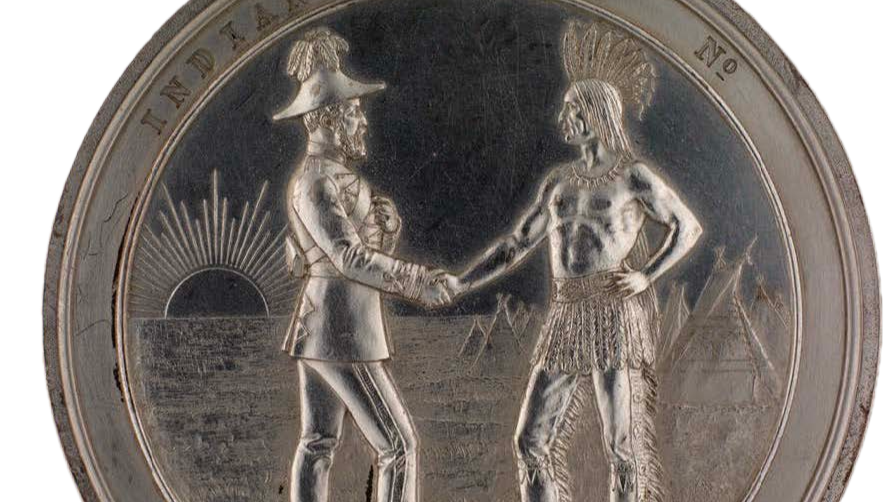
On September 18, 1878, the Michel band entered Treaty Six by way of adhesion. The adhesion was signed by Chief Michel Callihoo. Treaty Six was previously signed by other Nations in 1876.
-
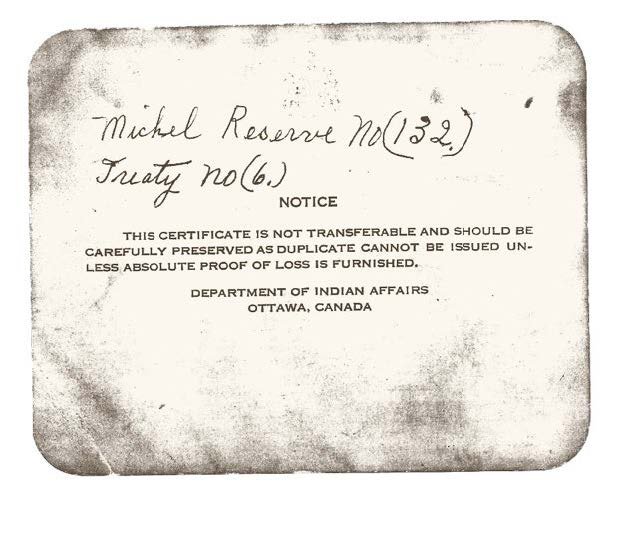
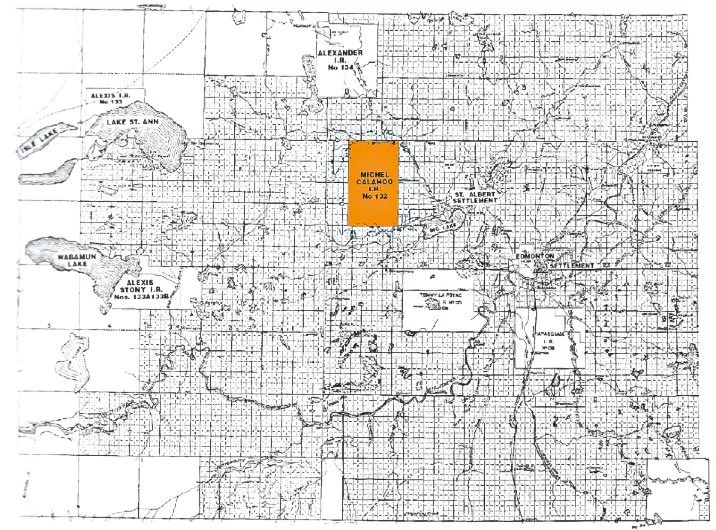
A 40-square-mile reserve (or 25,600 acres) was surveyed as "Michel I.R. 132" on the Sturgeon River, situated about sixteen miles from Edmonton, on the southern side of Sturgeon River. The I.R. was confirmed by Order in Council PC 1151 on May 17, 1889.
-
The federal government pressured many Western Indian Bands, including the Michel Band, to surrender large portions of Michel I.R. 132so the land could be opened up for European settlers. Many of these surrenders were later found to be tainted by fraud, unconscionable and/or illegal use of public authority and breach of trust.
-
Between 1903 and 1910, the Michel Band was repeatedly pressured to surrender parts of its reserve in exchange for agricultural implements promised under Treaty Six.
In 1906, after considerable pressure from Frank Oliver and officials of the Indian Affairs (and the promise of horses and farm equipment), the Michel Band agreed to part with some of its reserve lands. At the auction sale in December of that year (supervised personally by Oliver), 8,200 acres comprises of Surrender of 7,800 acres (ILRS Reg #8708-290 *in shared folder) and Surrender of 2,400 acres (ILRS Reg #8709-290) of Michel land sold in four hours at a price of $9.00 an acre. Three-quarters of the land went to two speculators, Frederick Grant and Christopher Fahrni, who were both political allies of Oliver and the Laurier government.
By 1910, neither speculator had yet paid a cent of the purchase price. Under the Indian Act, the sales ought to have been cancelled immediately for non-payment. In the case of the Grant lands, the sales were not cancelled until 1927, after continuing futile attempts to secure payment. Indian affairs had cancelled the Fahrni sale in 1910 — only to withdraw the cancellation a few days later without explanation. Shortly thereafter, the Fahrni lands were sold to Edmonton bank manager J.J. Anderson at a quarter of their original purchase price. In 1914, Anderson transferred title to these lands to his father-in-law — none other than Frank Oliver.
-
Chief Michel Callihoo, who signed the Michel Band's Treaty Six adhesion in 1878, passed away at his home. His nephew, Louis Jerome Callihoo, became the second Chief.
-
The Crown transferred roughly 41 acres of Michel I.R. 132, without consent or appropriate compensation.
-
Solomon Callihoo became Chief of the Michel Band.
-
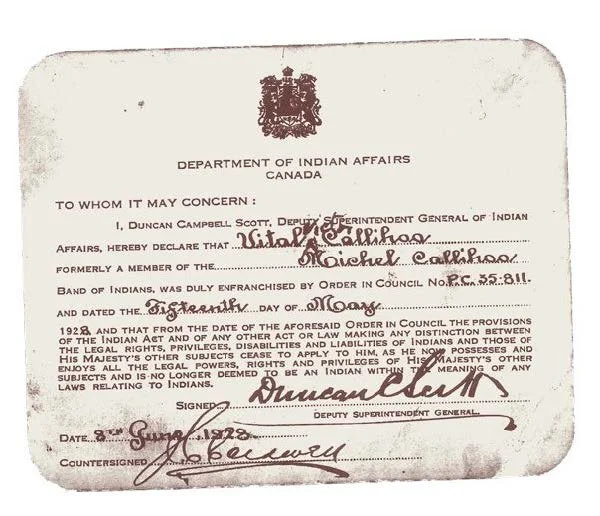
Ten Michel Band families "enfranchised" — giving up their Indian status — on the recommendation of an Enfranchisement Board appointed under Section 110 of the 1927 Indian Act, so their children would not be forcibly removed from their families and home to residential schools and to be able to farm and sell their grains without the confinement of the Crown and the Indian Agent overseeing/controlling... not sure on how to state overseeing/controlling politically correct/diplomatically.
-
On October 14, 1929, the Michel School opened, named in honour of the Michel Band's first Chief, Michel Callihoo.
-
Fred Callihoo became Chief of the Michel Band.
-
Neighbouring settlers pressured Michel Band members to enfranchise. Some accepted enfranchisement so their children could get a proper education and to escape the restrictions of the Indian Act.
After the Second World War, additional pressure grew as returning veterans needed agricultural land — and some Michel Band veterans, unable to access the same benefits as other Canadian veterans while under the Indian Act, applied for enfranchisement themselves.
-
Roderick Callihoo became Chief of the Michel Band.
-
The Department of Indian Affairs wanted to make Michel the model for Band enfranchisement across Canada. A Committee was appointed pursuant to Section 112 of the 1952 Indian Act to inquire into and report on the desirability of enfranchising the Band. The Committee reported to the Minister of Citizenship and Immigration that, in its opinion, the Michel Band of Indians was capable of managing its own affairs as a municipality or part of a municipality, and advised that it was desirable that the Band be enfranchised.
On March 31, 1958, the Department of Indian Affairs enfranchised all but four women and one child of the Michel Band. They were removed from the Michel Band membership list and placed on a General List, prior to the March 31, 1958 enfranchisement. These individuals were not enfranchised - they lost their Band membership but kept their Treaty status. This action was the beginning of the Alberta General List (838).
On March 31, 1958, the entire Michel Band was enfranchised by Order in Council P.C. 375 — the only entire Indian Band in Canada ever enfranchised this way — stripping every member of Indian status and Band membership.
-
Under amendments to the Indian Act (Bill C-31), over 750 Michel Band members have their Indian status restored.
However, Bill C31- still had no mechanism to restore Band Status for Michel members and descendants enfranchised as part of the Michel Band's collective 1958 enfranchisement.
-
Members of the former Michel Band filed a Specific Claim alleging:
(1) that the enfranchisement of various band members in 1928 and the entire Band in 1958 were invalid; and
(2) that Canada breached its statutory and fiduciary duties in relation to various surrenders of reserve land obtained from the Michel Band in the early 1900s
Canada refused to accept this claim. The Specific Claims Policy limited the submission of claims to recognized bands, and refused to consider the alleged impropriety of the surrenders. Aspects of the claim were considered to determine whether the claimants were entitled to be recognized as a band. Canada concluded that the Michel descendants were not entitled to such recognition.
-
Bill C-31 let individuals reclaim Indian status under various sections of the amended Indian Act — but it still had no mechanism to restore status for members and descendants enfranchised as part of the Band's collective 1958 enfranchisement under Section 112 of the previous Indian Act.
-
Surviving Michel Band members were invited to an assembly in Enoch. 158 people attended, and Gilbert Anderson — great-grandson of the original Chief Michel Callihoo — was elected Chief.
-
The Michel Band requested the Indian Claims Commission inquire into Canada's refusal to accept its claim on behalf of the Friends of Michel Society.
-
The Indian Claims Commission, co-chaired by Jim Prentice, released its report. It found that Bill C-31 did not restore Band status to Michel, and that Canada's Specific Claims Policy applied only to Bands.
However, it was found unfair to let Canada benefit from a discriminatory and illegal enfranchisement policy it had itself repealed in 1985. The Commission recommended Canada grant the Friends of Michel Society special standing to submit specific claims in relation to the alleged invalid surrenders of reserve land for consideration of their merits under the Specific Claims Policy.
Report can be found here.
-
The Standing Senate Committee on Aboriginal Peoples met on February 16,1999 in Ottawa to discuss self-government. Chief Gilbert Anderson and legal counsel Karin Buss appeared before the committee to raise the Michel Band's issue.
-
After federal Minister of Indian Affairs Robert Nault rejected the ICC's recommendation, the Friends of Michel Society filed a Statement of Claim in the Court of Queen's Bench of Alberta.
The Society was required to file this claim so that its claims would not be extinguished by the passage of time as a result of the Alberta Limitations of Actions Act.
-
After the Statement of Claim was filed (2001) and served (2002), the Government of Alberta and the Government of Canada spent years trying to have the case dismissed. In 2005, both Alberta and Canada sought summary judgments.
In February 2006, the Court dismissed Friends of Michel Society's claim against Alberta entirely and part of its claim against Canada. Friends of Michel Society appealed this decision.
In 2007, the Alberta Court of Appeal overturned the decision, reinstating Friends of Michel Society's full legal action.
In 2008, Amended Statement od Claims by Friends of Michel Society and Statement of Defence by Canada were filed. These documents were submitted in preparation for trial.
-
The Chiefs of Treaty Six recognized the Michel Band as a member of Treaty Six and called on the federal government to restore recognition of Michel's descendants and members as an Indian Band under Section 2 of the Indian Act.
-
In 2018, Canada reached out to Friends of Michel Society to participate in without prejudice exploratory discussions regarding Band reinstatement.
-
In 2022, Friends of Michel Society joined together with 4 other groups (Michel Corporation; Descendants of Michel First Nation Association; Unity Group; Michel Band United for Justice) by signing the Michel Callihoo Nation Advisory Group (MCNAG) Protocol Agreement. All Parties agreed to form an Advisory Group comprised of 2 members appointed by each of the groups to participate in Band creation exploratory discussions with Canada.
-
In November 2022, the Michel Callihoo Nation Society (MCNS) was incorporated.
Discussions with the Government of Canada advocating for the reinstatement of the Michel Band commenced in 2023.
-
Although Friends of Michel Society is no longer involved in discussions with the Government of Canada, we remain committed to:
Support efforts to create an Indian Act Band for the descendants of the former Michel Indian Band No. 472, led by democratically elected representatives chosen by the descendants to represent them in the Band creation process with Canada
Support individuals to track and provide information on family history and connections to the former Michel Indian Band No.472
Represent individuals who are descendants of the former Michel Indian Band No.472 and who have consented to being represented by FMS in duty to consult purposes
Provide support and assistance to descendants of the former Michel Indian Band No.472, subject to available resources.